


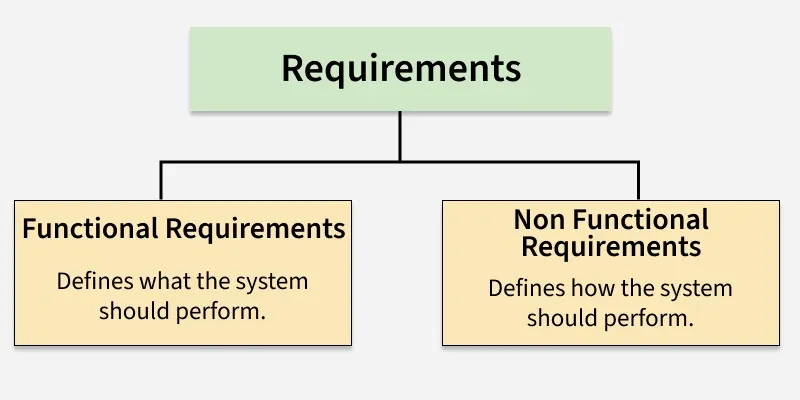
In software development, requirements define what a system should do and how it should perform. These requirements are broadly categorized into Functional Requirements and Non-Functional Requirements (NFRs).
Understanding the difference between the two is critical for building reliable, scalable, and user-friendly systems.
Functional Requirements
Functional requirements describe what the system should do.
They define the core features, behaviors, and operations of the system.
Key Characteristics:
- Focus on system behavior
- Define specific functionalities
- Usually expressed as use cases or user stories
- Directly tied to business logic
Examples:
- User can register an account
- User can log in and log out
- System can process payments
- Admin can generate reports
- System sends email notifications
Simple View:
Functional requirements = Features of the system
Non-Functional Requirements (NFRs)
Non-functional requirements describe how the system performs.
They define quality attributes, constraints, and performance expectations.
Key Characteristics:
- Focus on system quality and performance
- Define how well the system works
- Often measurable
- Apply across the entire system
Examples:
- System should load within 2 seconds
- Support 10,000 concurrent users
- Ensure 99.9% uptime
- Data must be secure and encrypted
- Application should be scalable and maintainable
Simple View:
Non-functional requirements = Quality of the system
Key Differences
| Aspect | Functional Requirements | Non-Functional Requirements |
|---|---|---|
| Definition | What the system does | How the system performs |
| Focus | Features and functionality | Performance, usability, reliability |
| Examples | Login, registration, payment | Speed, security, scalability |
| Testing | Functional testing | Performance, load, security testing |
| Scope | Specific features | System-wide constraints |
Real-World Example
Scenario: E-commerce Website
Functional Requirements:
- Users can add items to cart
- Users can checkout and make payments
- Users can track orders
Non-Functional Requirements:
- Website loads within 3 seconds
- Handles 5,000 users simultaneously
- Secure payment processing (SSL encryption)
- System uptime of 99.9%
Why Both Are Important
- Functional requirements ensure the system works
- Non-functional requirements ensure the system works well
Ignoring NFRs can lead to:
- Slow applications
- Security vulnerabilities
- Poor user experience
- System failures under load
Final Thought
A successful software system is not just about features—it’s about delivering those features efficiently, securely, and reliably.
Functional requirements build the system
Non-functional requirements define the system’s quality
